Gemini Models: Scalable Contextual Intelligence

Defining Gemini Architecture
Direct Answer: Gemini is Google’s advanced family of multimodal Large Language Models, engineered from the ground up to understand, operate across, and combine different types of information—including text, audio, image, and video—with state-of-the-art reasoning and long-context performance.
The Multimodal Gap: Why Standard Models Struggle
Most language models are text-centric, utilizing secondary vision encoders to "translate" visual input into a text-compatible format. This translation layer inevitably loses structural, spatial, and geometric information. If a model cannot natively "see" a layout grid or a 3D light vector, it cannot reason effectively about how to transform that asset.
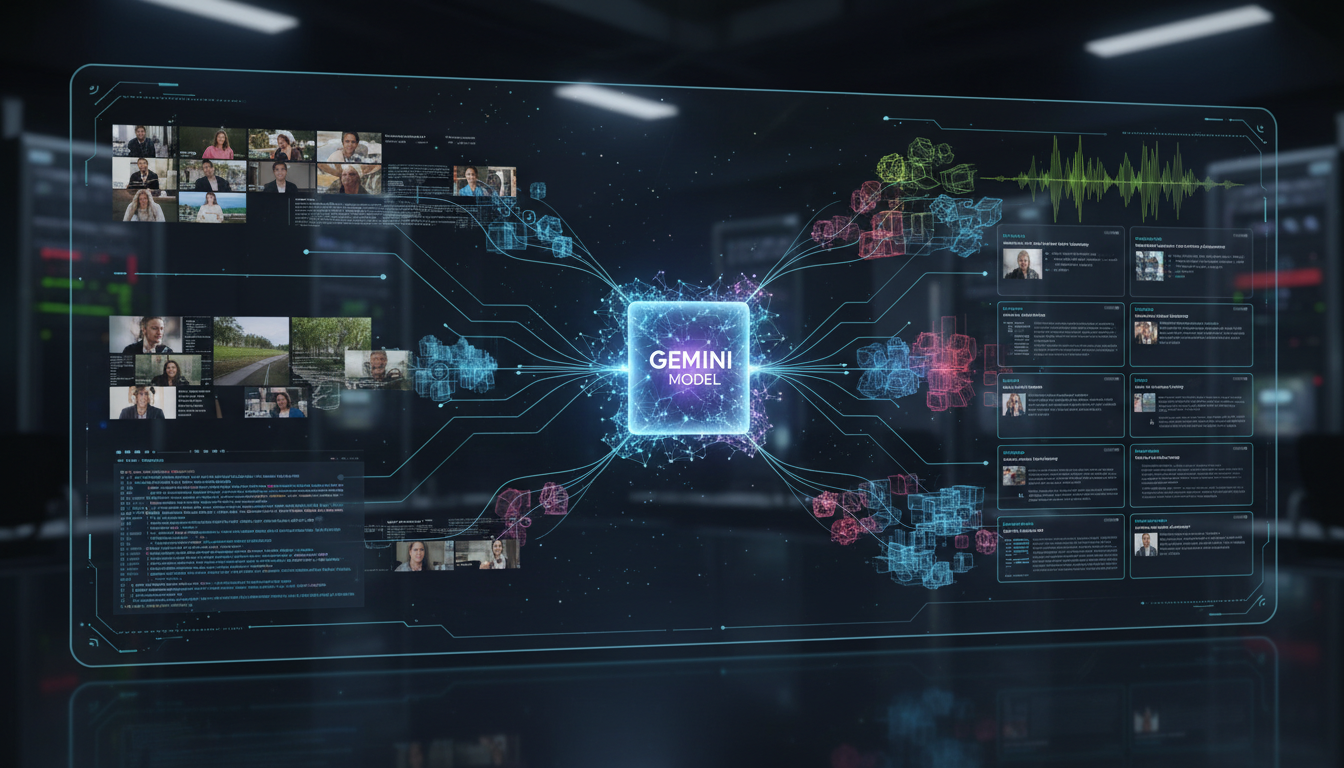
Gemini resolves this by utilizing a native multimodal architecture. Because the model is trained on visual and textual data simultaneously from the beginning, it maintains semantic understanding across input types. This allows for complex operations—such as analyzing a raw architectural sketch and generating structured layout variations, or understanding a video timeline while reasoning through narrative logic—without the need for clunky, error-prone translation layers.
Core Use Cases for Gemini Integration
The Gemini family enables three high-value workflows for creative teams:
- Unified Asset-to-Logic Processing: Directly ingest and interpret complex visual assets—like product design files or layout mockups—and transform them into production-ready specifications, stylized image variations, or editorial content.
- High-Speed Multimodal Reasoning: Use Gemini to reason through complex, cross-domain project requirements where the AI must simultaneously interpret long-form documentation, analyze visual data, and generate precise creative output.
- Automated Workflow Orchestration: Build multi-step production pipelines where the model dynamically assesses visual and textual inputs to route tasks across different generation nodes, ensuring that every asset remains on-brand and on-brief.
Technical Constraints of Multimodal Models
While Gemini provides unparalleled reasoning and perception, users must consider the model's specialized operational boundaries:
- Resource-Intensive Inference: Because the model manages high-dimensional multimodal tokens simultaneously, deep reasoning tasks require significant GPU throughput, leading to higher latency for ultra-complex, multi-layered visual queries.
- Complexity Management: Gemini's high intelligence is best harnessed with structured prompt logic. Overly broad or ambiguous instructions can lead to "reasoning bloat," where the model explores too many parallel logical paths, requiring clear constraints for focused output.
Why Choose LinkfilmAI for Gemini?
We integrate Gemini’s multimodal engine directly into your node-based workspace, bridging the gap between raw data and creative execution.
Instead of treating your AI as a separate, external step, LinkfilmAI connects your Gemini nodes directly to your image, video, and audio generation pipelines. You can route your parsed design documentation, analyzed video timelines, or structured briefs straight into your creative output nodes, ensuring your production process is driven by data-backed, multimodal intelligence.